Stop the press.

“Words I Love” will have to wait for another day.

(Iwon’twriteaboutLeBronIwon’twriteaboutLeBronIwon’twriteaboutLeBronIwon’twr—)

Alas, no. I need to address the video that’s gone crazy around the world. You know, the one that features a studio track of Britney Spears, singing without any enhancers such as Auto-Tune (software that, among other effects, corrects out-of-tune singing). First, listen to the recording.

Yikes. A bit painful in spots, but A-T can fix it, right? No big deal, so please, leave Britney alone. According to William Orbit, a producer who works with the singer:


I’d like to affirm that ANY singer when first at the mic at the start of a long session can make a multitude of vocalizations in order to get warmed up. Warming up is essential if you’re a pro, as it is with a runner doing stretches, and it takes a while to do properly. I’ve heard all manner of sounds emitted during warm-ups. The point is that it is not supposed to be shared with millions of listeners. A generous singer will put something down the mic to help the engineer get their systems warmed up and at the right level, maybe whilst having a cup of herb tea and checking through lyrics before the session really kicks off. It’s not expected to be a ‘take.’

Whomever put this on the Internet must have done so in a spirit of unkindness, but it can in no way detract from the fact that Britney is and always will be beyond stellar! She is magnificent! And that’s that.


Central to this sycophantic treatise is the kill-an-ant-with-a-Howitzer effort to defend her by inserting meaningless frabba-jabba about engineers getting “their systems warmed up” (whaa?), and basically stating with a straight face that it’s pretty much standard for professional singers to sing dreadfully — and repeatedly — out of tune during warm-ups. Dude really wants to take a bullet for this girl, Lawd. Strikes me as somewhat desperate.

Anyway, for what it’s worth, here’s my take. I’ve read lots of pro-Britney comments on several websites. I’ll paraphrase some here, followed by my response.

  1. It’s no different than Photoshop for photography. It’s designed to improve a performance; there’s nothing wrong with that. Well now, that’s a matter of how you define “wrong,” isn’t it? In my mind, there is plenty wrong with floating your image as a singer, and not being able to deliver the goods. To me, that’s lying to your fan base. It’s duplicitous and smug. Isn’t there an emerging movement to pressure magazines to take the Photoshop fakery and dishonesty out of photography? If you’re gung-ho about leaving one’s natural beauty to shine through, but all wiggle-neck and wave-finger about defending Britney’s artificial sweeteners, well…that makes you a hypocrite.
  2. She’s never claimed to be a great singer; she’s just a great performer. And that’s just a great huge subjective generalization. I guess it depends on what you want for your $170 concert ticket. Me? If I’m going to hear someone who has a song in the charts (and is therefore classified as a “singer”), my expectations are that the singing will be outstanding. I don’t want to hear the singing get short-shrifted because the singer is completely winded from all the ubiquitous dancing (as if concertgoers can no longer be entertained by a singer at a mic; they must have shiny, fast-moving, TV-like things to look at onstage and on mile-high projection screens, or else they’re bored). I don’t want to hear pitch doctors at work, tip-toeing through a minefield of possible clinkers, or worse — watch a lip-synced performance. Where’s the authenticity in that?  I watched Britney dummy along to her songs last night. It was clutch. Only in America, folks. Only in America.
  3. Everyone uses Auto-Tune nowadays. This statement is tragic in more ways than one.  A. I’ve read several comments from studio engineers who dismissively claim that A-T is “no big deal” — that it’s a long-established industry standard for correcting “small imperfections” in singers’ intonation. Long-established, eh? Auto-Tune was rolled out by Antares Audio Technologies way back in 1997. By my calculation, it’s been an “industry standard” for about 17 years, in an industry that began in 1889. What on earth were bad singers supposed to do before 1997? Fix the mistakesthat’s what, although some major misjudgments did slip through the cracks from time to time. As much as I loved The Association, they by-crackie screwed the pooch on Cherish and Never My Love. I can barely stand to listen to them, which is a shame because I like the songs a lot. The Mamas & Papas committed the same crime in Monday, Monday. While it’s not a singing gaffe, I can’t listen to Wings’s Band on the Run, because McCartney’s bass is so out of tune, it ruins the whole thing. And have you suffered through Club Nouveau’s 1986 Lean on Me bridge recently? Oh, you must. I’ll wait here. The point is, where were these hotshot producers then? Who let this stuff slide, and why? I’d love to know. B. Not “everyone” uses Auto-Tune. What bothers me most, I think, is that such a large portion of the music-listening public thinks it’s totally acceptable to lay down garbage on tape and let producers fix it. You know, in the “old days,” there was a method for fixing out-of-tune singing in the studio. It was called “punching in/out,” whereby the offending phrase was recorded over by the singer. The artist — the person with the ears and the voice — did the fixing. I’ve done it myself in my own recording sessions, many times. What happened to that practice, and why is it OK in today’s recording culture for singers to walk into a booth, take a musical crap, and leave it for others to clean up later? The reasons are multi-layered and outside the scope of music, so I’ll leave it there for today.

Of course, the cure is to not listen to artists who bother you, or who thwack your intonation sensibilities. Better still, do listen to three singers who never had the Auto-Tune option, yet rarely ever recorded a single note that didn’t ring true: Frank Sinatra, Ella Fitzgerald and John Lennon. In the studio or live onstage — it made no difference. They were as near perfect as anyone could be. And no one “cleaned up” after them.

As for Britney:  she’ll get through this without a scrape. Naughty bits of this girl have been exposed in the media before, and it’ll likely happen again. I think she’s not devoid of singing talent, by the way. I think she sings music in keys that are way too low for her, and as any singer will tell you, doing so is decidedly unhelpful in the intonation department. She is also Queen of the Vocal Fry, and I’d be lying if I told you I didn’t want to cold-cock her for it. STOP *sLAp* singing like an idiot! But to paraphrase Boston, there’s just something about her that continues to boost her record sales. We won’t go into that today, either. :-D

Hey, it’s almost Finkday! What does it MEAN?? I don’t know!! I’m on vacation!

Words I Hate

Am I mental? Probably. But as some of you may know, there are certain words and sayings I cannot abide (which of course means that all my friends and family who read this will henceforth endeavor to use them in a sentence every chance they get).

Why do I hate certain words/phrases? Several reasons: icky mouth feel, pretentiousness, misuse, mispronunciation, overuse, just plain dumb. Behold a partial list, because neither of us has that kind of time:

Words and Phrases I Hate

Beaucoup.  Now I love French, but when people mispronounce this particular word (“boo-coo”), I think violent thoughts. “He’s got boo-coo bucks to throw around.” Seriously, if you’re going to impress us with your cosmopolitan foreign language flair, you really need to get this right (“boe-coo”).

Treacly. Please. Simply say “overly sentimental.” The extra five syllables won’t kill you.

Interwebs. Just…

My bad. I know this might put me squarely in the fogie category, but as a teacher of 10- through 18-year-olds, I might be justified in wanting to drop people who say it.

My AMAZING boyfriend! It’s not that the words amazing and boyfriend are offensive; they’re not. It’s the constant use of them together to describe your sweetheart that makes me want to punch things. What amazes you about your boyfriend, truly? To be amazed is to be filled with astonishment; astounded, stunned, staggered, in awe, stupefied. That’s a tough gig for anyone to live up to, dudes. Again, maybe you don’t hear/see these things as often as I do because you don’t spend nine months a year with hundreds of teenagers.

Clutch. In addition to describing the mechanism that separates two drive shafts in a manual transmission automobile, or classifying a great play in sports that came just at the right time, clutch is now being used as a synonym for cool. “Those new Jordans are clutch!”  Oy.

Kiddos. When used as a ruffle-the-hair term of endearment to ONE person, it’s fine. Using it ad nauseam to refer to one’s children (or a classroom full of students) is like chewing foil. I’ve heard school administrators use it to the exclusion of all other words meaning “children” while giving a 30-minute speech. Dreadful. Why? I ask you. Why can’t everyone just follow my rules?

____ Porn. Food porn, shoe porn, dress porn…I can’t think of any other examples. Does using porn after something you can’t get enough of make you feel naughty? Well, bless your heart and good for you. Now put yourself in time-out.

Yummo! I’m serious. *KaBLaM*

Panties. Don’t say this word around me — especially with the words big girl anywhere near it.

Cutie Patootie. If Rosie O’Donnell said it once on her talk show, she said it 3249869384669846 times. Totally ruined it.

Tuckus. While we’re on the subject of butts: I hate this word, too. It sounds like someone trying to speak after having just bitten into a huge lemon. It’s also creepy; ventriloquistic and sneaky.

OK, OK. Enough’s enough. I hope that, while I really dislike these words and phrases, you can see it’s all done in fun. If you use these words, or if you’re particularly fond of some of them, I will apologize ahead of time for offending. It’s never my intention. I’m also prepared for the Godwin’s-Law-like comment(s), “Well, I hate the word [something I said above].” Go for it. I deserve it.

In fact, to illustrate my good will:  Tomorrow — Words I Love! ;-)

RNF LXII

There are many things on my mind this morning, but I’ll settle on two for today. Y’know, save the rest for later.

First: Go spend four dollars at Amazon and buy this book. Written by none other than RtB’s own Ross, it’s a fascinating collection of quotes by and about musicians from long ago up to right now. I’m on page…well, I’m not sure what page I’m on because this Kindle thing on my phone doesn’t give page numbers, but I’m in the “B” section (the authors of the quotes are listed alphabetically). One of my favorites so far:

One of the main sources of mental corruption in this country is the ghost of Vince Lombardi:  Don’t matter how you play the game, don’t matter if you enjoy the game, don’t matter if the game means anything, the important thing is to win. I think that’s as good a definition of mental illness as you’re gonna get.  ~Jello Biafra, Dead Kennedys

Haha — true. Seriously, it’s not your typical “quote book,” if the “A” section is any indication. Hoist it on over to Amazon and buy it.

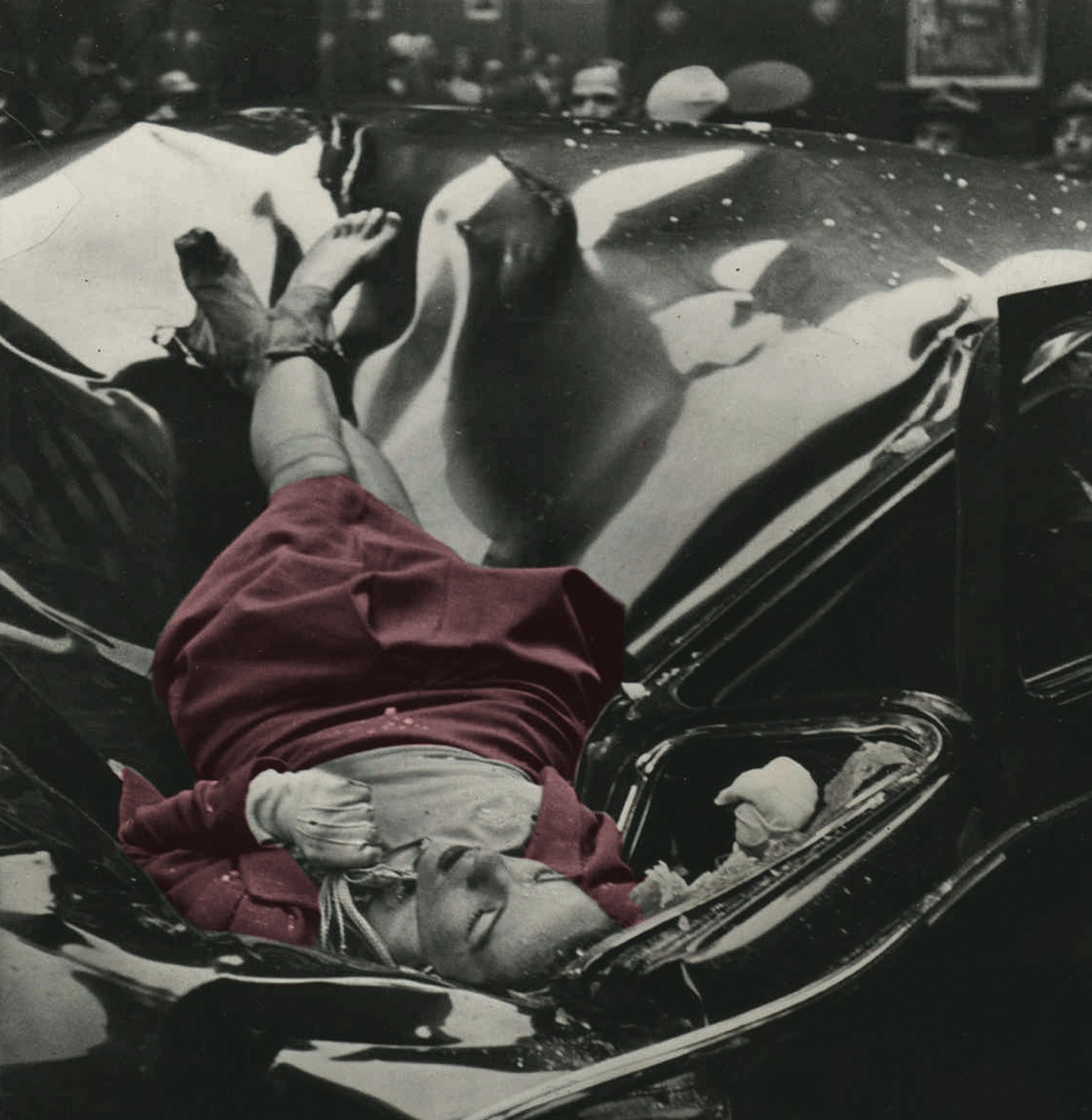
Second: While doing some early morning research the other day, I came across a 1947 headline from LIFE magazine. It read, The Most Beautiful Suicide. Without even clicking on the link, I knew the photo the title referenced: the tragic leap by 23-year-old Evelyn McHale from the Empire State Building.

She’d recently gotten engaged, but according to her suicide note, she didn’t feel worthy. The photo here is a dramatically colorized version of the original Robert Wiles picture (the only photograph he ever published), showing Evelyn in surreal, peaceful repose, with her ankles crossed, skirt hem at a respectable display length, and still holding her necklace. LIFE ran the photo (many publications refused) on a full page two weeks later, with the following caption:

On May Day, just after leaving her fiancé, 23-year-old Evelyn McHale wrote a note. ‘He is much better off without me … I wouldn’t make a good wife for anybody,’ … Then she crossed it out. She went to the observation platform of the Empire State Building. Through the mist she gazed at the street, 86 floors below. Then she jumped. In her desperate determination, she leapt clear of the setbacks and hit a United Nations limousine parked at the curb. Across the street, photography student Robert Wiles heard an explosive crash. Just four minutes after Evelyn McHale’s death, Wiles got this picture of death’s violence and its composure.

I’ve had some pretty low moments in my life, to be sure. I think it’s safe to say we’ve all had them. But to be so low — so miserably desperate and despondent — as to consider ending it all, and by leaping off a building? I can say, mercifully, that I’ve never been in that place. I hope I never will be.

I don’t mean to be morbid or gloomy today; I’m actually in great spirits (I will get things done today or ELSE). Rather, I just write what results from the neurons doing their random job.

So, I’m happy! And I love my job. And the Tribe won again last night. And NO — LeBron isn’t coming back to the Cavaliers. (Now watch me eat those words someday…)

Review: The Grand Budapest Hotel

Some films are hard work, even if they’re great; you really have to put in overtime to hang onto the story, or care about certain characters, or achieve some manner of closure at the end. The Grand Budapest Hotel isn’t one of those movies.

If you’re a fan of Wes Anderson, this one is a shoo-in. I’ve come to the point where I don’t even need to see the credits roll– I just know it’s an Anderson film. Why? There are several reasons, all having to do with color, patterns, quirky locations, whimsical suspension of disbelief (where you know it’s impossible, but you’re enchanted by it anyway because the director makes no effort to mask its improbability with zippy special effects), and stories and characters that are ever-so-slightly off. This is why I like Wes Anderson films.

However, a treatise on what makes a movie “Wes Andersony” is better left to those who know his work more intimately. Back to Budapest.

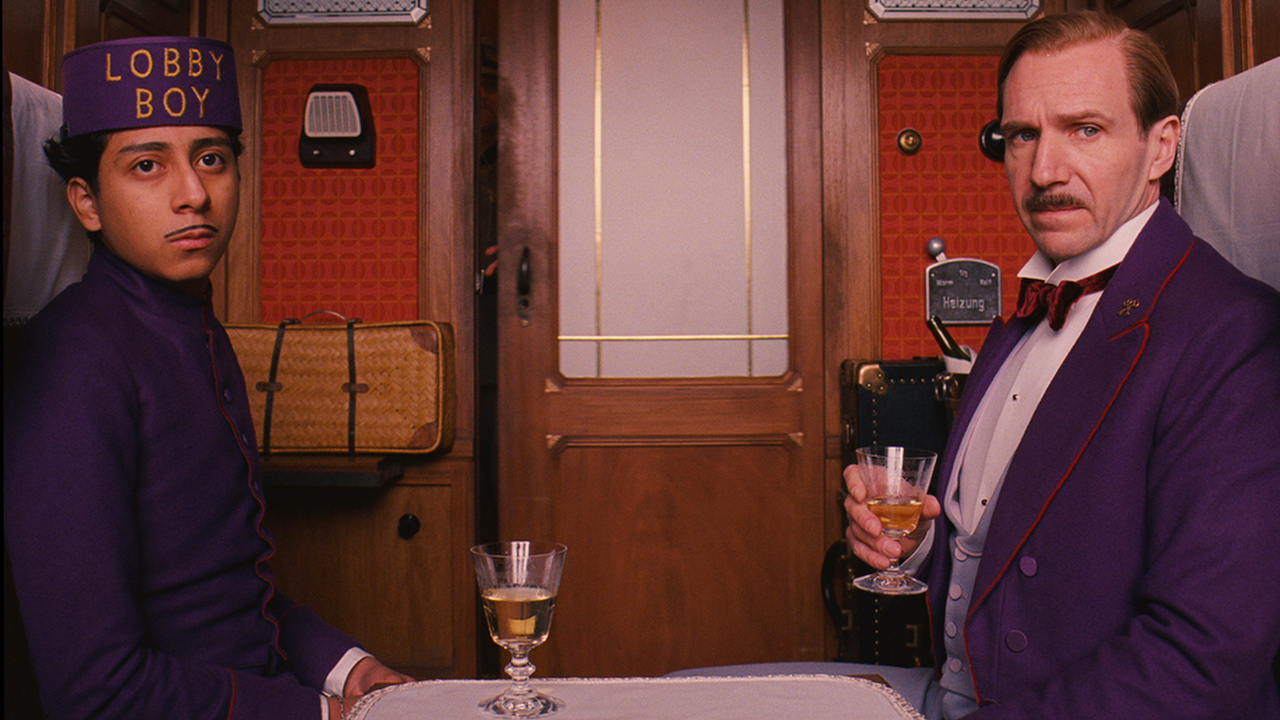
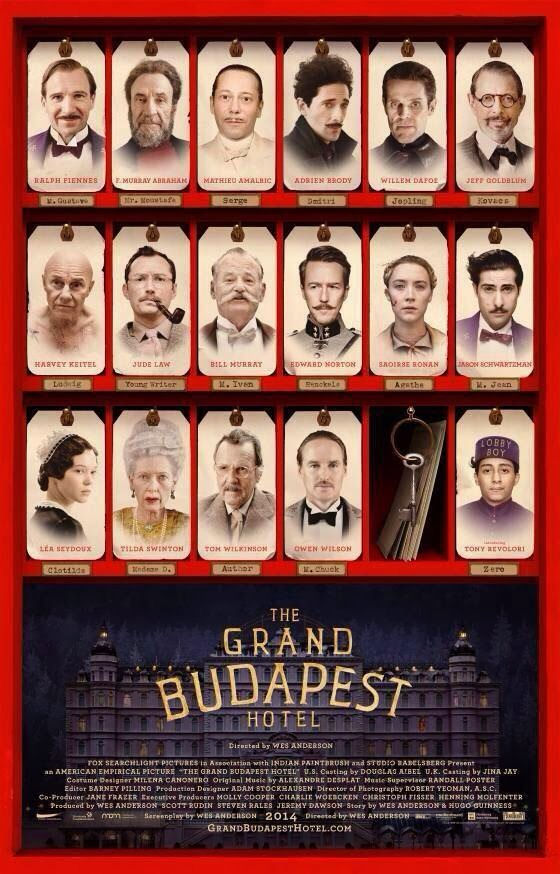
As with many Anderson stories, the tale takes place completely in the past — the 1930s in this case, between the major European wars — in a made-up Bavarian country. Ralph Fiennes is brilliant as the hotel concierge who befriends and mentors a shy, awkward, yet exceptionally intelligent lobby boy, with whom he eventually shares a crazy adventure involving art theft, murder, a prison escape, and a beyond-silly alpine ski/toboggan chase filmed in obvious miniature (which, of course, makes it all the more enjoyable). Fiennes’s performance in this film could stand as the singular reason to watch it; he will be forever linked to that role, as Gene Hackman is to his part in The Royal Tenenbaums. Spectacular, and fun to watch. If he isn’t nominated for a Best Actor Oscar come January, I’ll be disappointed.

And speaking of actors, Anderson uses the standard horses in his stable of performers, who would all probably do the gig for free just to work with him. Among the usual suspects: Owen Wilson, Bill Murray, Tom Wilkinson, Tilda Swinton, and others. To some, this might seem tedious, but to me, it’s a familiar, comfy blanket of knowing what to expect.

One thing, though…through no fault of his own, the wonderful F. Murray Abraham, around whose character the movie centers, spoke in a tone so exactly like his role as Antonio Salieri in Amadeus, I couldn’t separate the two. It was as if at any moment, I expected to hear him speaking Italian. Weird.

The ending was the perfect mixture of nostalgia, satisfaction and sadness, with a huge nod to the sanctity of family and enjoying what life gives you, and treasuring the memory of what it takes away.

If you liked Moonrise Kingdom, The Life Aquatic with Steve Zissou, and The Royal Tenenbaums, you’ll like this film even more.

On the Rat-O-Meter scale of five cheeses, I give The Grand Budapest Hotel:

Ashokan Farewell

I can’t tell you how this beautiful song haunts me.

Recently, the Thriller and I reached the end of Ken Burns’s epic docu-series The Civil Warwhich I’d seen 20-some years ago, but wanted to revisit. It was at the same time awesomely inspiring and crushingly sad. Americans inflicting such hideous, wholesale war violence on other Americans is, to us today, almost inconceivable. And yet, because it happened, we have been for the last 150 years spared a repeat performance. At no time in our relatively short history have we come so close to complete anarchy: something Abraham Lincoln feared most as he took office in 1860, facing the real threat of secession by southern states.

But back to the music. This beautiful tune threaded its way through all nine episodes, and became an expected, familiar backdrop to the many heartbreaking scenes of the war, depicted in countless photographs and actor-voiced testimonies from soldiers, politicians, family members and generals. A listener’s first impression would definitely be This is a tune from the Civil War era, but he would be mistaken.  Ken Burns approached Jay Ungar, renowned fiddle player and performer of traditional American music, who’d written “Ashokan Farewell” in 1982, asking the musician if he could use it as a theme for the documentary, as the song had touched him deeply. Not only did Ungar give his permission, but he and his band played all the music heard in the nine-part series. “Ashokan” was the only piece in the film not from the 19th century.

If you close your eyes and listen, where does this song take you? Perhaps you’ve heard school choirs sing it over the years, as it’s been a popular “folk song” choice for many directors, with its simple melody and beautiful phrasing. Maybe you’ll immediately feel the sense of wistful longing — what I like to call a “pulling” sensation on the soul — in the song’s haunting simplicity. Regardless, I think you will find it a thing of beauty:  something we need more of in this world.

This is how the film begins. I highly recommend you experience it in its entirety one day.